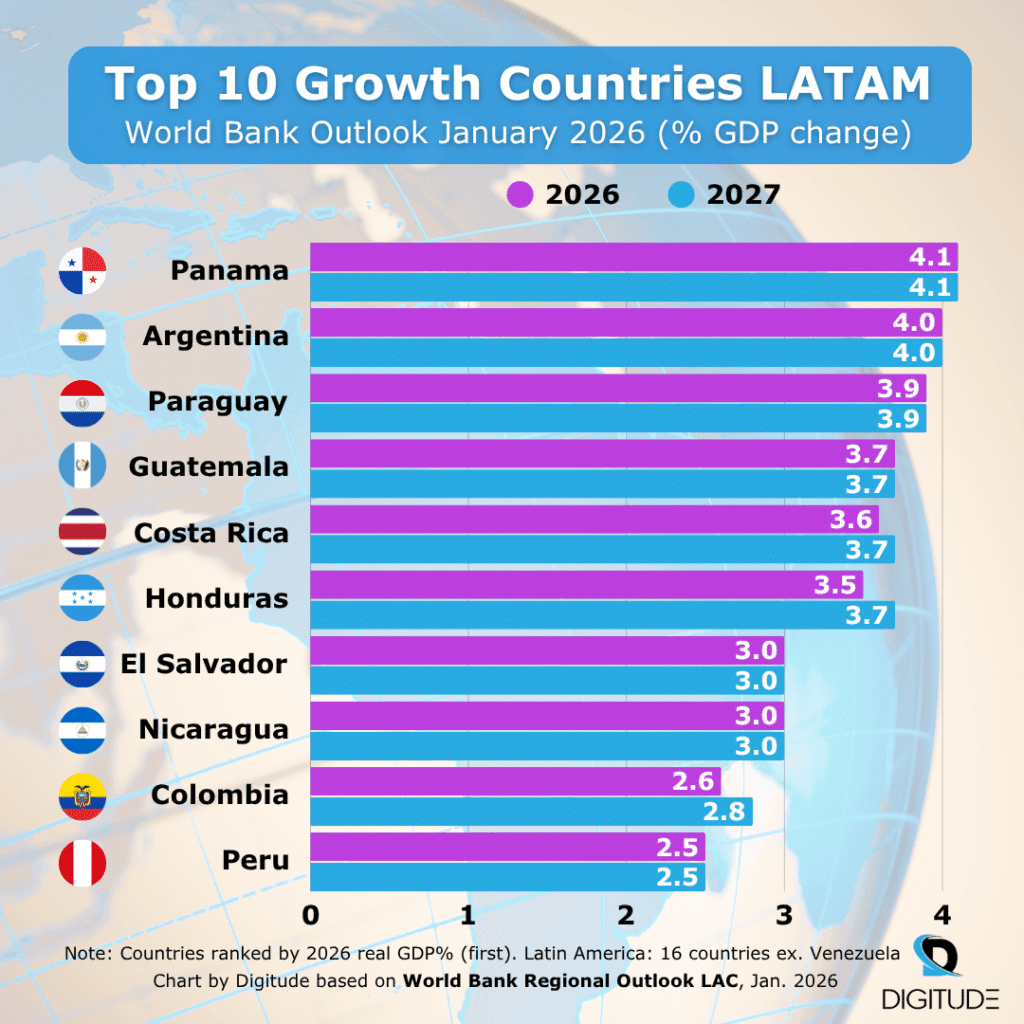
Economic growth in Latin America and the Caribbean is expected to recover modestly, rising from an estimated 2.2% last year to 2.3% in 2026 and 2.6% in 2027. This according to the World Bank’s Regional Outlook January 2026 published last week.
Easing financing conditions and strong metal and food commodity prices are supporting growth, but they are expected to be partly offset by ongoing trade tensions, uncertainty, limited fiscal space, and weak consumption and investment in several markets.
In 2025 the regional economy grew 2.2% in 2025, according to the World Bank’s forecast. Private and public consumption and investment were higher than anticipated in the June forecast.
Growth in Largest LATAM Markets
🇧🇷 Brazil’s growth is expected to slow to 2.0%, a downward revision of -0.2%, before picking up to 2.3% in 2027, due to high real interest rates, negative trade developments, and global uncertainty. Growth in 2025 was 2.3%.
🇲🇽 Mexico is projected to grow by 1.3% in 2026 and 1.8% in 2027, as it recovers from trade policy uncertainty and companies adjust to the new trade landscape. Growth in 2025 was 0.2%.
🇦🇷 Argentina’s economy is forecast to grow 4% in both 2026 and 2027, a downward revision of -0.5% for 2026, because domestic policy uncertainty is expected to weigh on demand in 2026. Last year’s growth was 4.6%
🇨🇴 Colombia is projected to expand by 2.6% in 2026 (same as in 2025) and 2.8% in 2027, supported by resilient consumption and a gradual recovery in private investment.
Panama Leads LATAM Growth with 4.1% 📈
Panama’s economy is projected to grow by 4.1% in 2026, driven by finance, business, and logistics services (which are isolated from tariffs). Foreign direct investment expected to continue financing the current account deficit. The upward revision of 0.3% makes it the country with the highest growth in Latin America, moving from 3rd to 1st place in the ranking. In 2025 growth was 3.9%.
Next is Argentina 🇦🇷 with 4% in 2026 & 4% in 2027, followed by Paraguay 🇵🇾 (3.9% in 2026 & 2027).
Risks to the Outlook
The outlook is more likely to be influenced by negative developments than positive ones. Higher trade barriers and ongoing uncertainty could weaken exports, investment, and government revenues, especially if commodity prices fall. Especially Mexico is vulnerable due to its large trade exposure to the U.S. With debt levels already high, tighter global financial conditions could trigger capital outflows. Climate shocks also remain a material risk, particularly for exposed sectors such as agriculture, fisheries, and energy.
On the upside, wider adoption of artificial intelligence could lift productivity, particularly in countries with more highly educated workforces that are better positioned to capture its benefits. At the same time, AI adoption may disrupt labor markets across the region.
Global Economic Prospects January 2026
Regional Outlook Latin America & Caribbean January 2026